Monthly Archives: October 2013

Fatal attractors

sauleda 01Me, in a pastelería (cake shop)

¿Qué es eso?

¿Cuál?

Ese pastel, allí.

Tarta de manzana.

¿Y aquella aquí… ¿Qué lleva?

Crema.

Si, quiero una de este.

Which translates, more or less, as:

What is that?

Which?

This cake, over there.

Apple tart.

And that one here, what’s in it?

Cream.

Yes, I want of one of this.

The translation is meant to convey the fact that the demonstratives (eso, ese, aquella, etc) are all over the place – literally – and only accidentally coincide with where I’m pointing, and with the gender or number of the thing pointed at. And, more tellingly, were I to have the same conversation again tomorrow, I might well use a whole different combination, plucked off the shelf, as it were, in a similarly random fashion.

This is as good an instance as any of how my Spanish, or pockets of it, functions in a state of ‘free variation’.

At some point, I must have been aware of the range of choices available for identifying objects near to me, near to you, and distant from both of us, and how these demonstrative adjectives and pronouns are also sensitive to number and gender, such that any decision to use one requires making a selection from 15 different options (see table below).

Understandably, I resisted learning the rules of a system that seemed impossibly complicated (three deictic points, three genders, as well as singular and plural). Instead I simply pulled demonstratives out of a hat, applying them indiscriminately, and sometimes throwing in a Catalan one for good measure. Of course, the physical context of the situations in which these items are typically used meant that pointing and eye-gaze made up for whatever incoherence resulted from my capricious grammar. Hence, there was little or no feedback as a result of miscommunication. I got the cakes I wanted.

pastelesAnd so the system (or lack of system) became entrenched. The same thing, more or less happened with past tense forms, with dependent prepositions, with clitic pronouns, with por and para, and with ser and estar. There are even sets of like-sounding words that I also deploy in free variation, the verbs planear, plantear, plantar, and planificar being a case in point. These wildly chaotic sub-systems seem to co-exist alongside other systems that are relatively stable.

In complexity theory, the fluctuations between relative stability and instability within dynamic systems are well attested. As Lewin (1993. 20-21) puts it:

Most complex systems exhibit what mathematicians call attractors, states to which the system eventually settles, depending on the properties of the system. Imagine floating in a rough and dangerous sea, one swirling around rocks and inlets. Whirlpools become established, depending on the topography of the seabed and the flow of water. Eventually, you will be drawn into one of these vortexes. There you stay until some major perturbation, or change in the flow of water, pushes you out, only to be sucked into another. This, crudely, is how one might view a dynamical system with multiple attractors.

Language learning is similarly ‘chaotic’: as Larsen-Freeman (2006: 592) notes, ‘There are no discrete stages in which learners’ performance is invariant’. And she adds (p. 593) ‘Learners do not progress through stages of development in a consistent manner. There is a great deal of variation at one time in learners’ performances and clear instability over time’.

The transition from one attractor state to another is called a phase shift, and one definition of fossilization might be ‘the absence of phase shifts’. Thus, Ellis (1999: 472) argues that ‘fossilization arises when learners fail to resolve the inherent variation in their interlanguage’. Witness my demonstratives.

But proponents of complexity theory would argue that any such stasis is an illusion: there is no permanent ‘end state’ in evolving, dynamic systems.  Hence ‘if there is no end state to language, it may be unhelpful to think in terms of fossilization as an end state to second language learning’ (Larsen-Freeman & Cameron, 2008: 10).

In a study of five Chinese learners of English, Larsen-Freeman tracked the ‘messiness’ of individual learning trajectories – a messiness not dissimilar to my random use of demonstratives. Larsen-Freeman conjectured that this very messiness might be indicative of the ‘instability that precedes a phase shift’ (2006: 611). And she adds, suggestively, ‘It is here where a pedagogical intervention might be optimal’ (ibid.).sauleda

What kind of pedagogical intervention?

I am drawn back to one of my favourite language learning accounts. Christopher Isherwood (1977:76), the writer, describes how he overcame a gap in his linguistic competence:

…Humphrey said suddenly, “You speak German so well – tell me, why don’t you ever use the subjunctive mood?” Christopher had to admit that he didn’t know how to. In the days when he had studied German, he had left the subjunctive to be dealt with later, since it wasn’t absolutely essential and he was in a hurry. By this time he could hop through the language without its aid, like an agile man with only one leg. But now Christopher set himself to master the subjunctive. Very soon, he had done so. Proud of this accomplishment, he began showing off whenever he talked: “had it not been for him, I should never have asked myself what I would do if they were to — etc., etc.” Humphrey was much amused.

In much the same way, I’m approaching the ‘holes’ in my own competence. How? A good old-fashioned students’ grammar, and a workbook of exercises. Hopefully, I will be able to find opportunities to activate, in real contexts (like the pastelería), the explicit knowledge gained from this mechanical practice, and trigger some kind of phase shift.

I’ll let you know how it goes.

Formas del pronombre demostrativo (from Sánchez Pérez & Sarmiento González 2005)

Formas del pronombre demostrativo (from Sánchez Pérez & Sarmiento González 2005). Click to enlarge.


References:

Ellis, R. (1999) ‘Item versus system learning: explaining free variation’, Applied Linguistics, 20/4, 460-80.

Isherwood, C. (1977) Christopher and His Kind: 1929-1939, London: Eyre Methuen.

Larsen-Freeman, D. (2006) ‘The emergence of complexity, fluency, and accuracy in the oral and written production of five Chinese learners of English,’ Applied Linguistics, 27/4, 590-619.

Larsen-Freeman, D. & Cameron, L. (2008) Complex Systems and Applied Linguistics, Oxford: Oxford University Press.

Lewin, R. (1993) Complexity: Life on the edge of chaos, London: Phoenix Books.

Sánchez Pérez, A. y Sarmiento González, R. (2005) Gramática práctica del español actual, Madrid: SGEL.


Why Spanish?

habitacionesWhy I have I chosen to crank up my Spanish – as opposed to any other language? The question might seem baladí, i.e. trivial or redundant, given the fact that I live in Spain, and am exposed to Spanish on a daily basis.  But I also live in Catalonia, where Catalan is the mother tongue of at least half the population, and is spoken and understood by a good many more.  Moreover, as Catalonia drifts inexorably towards secession from greater Spain, it might be politic to throw in my lot with the language that is so inextricably identified with its nationalist aspirations. What’s more, in the town where I spend most weekends (see pics), Catalan is the language of choice, and I might be better accepted, and hence more fully integrated, if I could speak it well.

So, why Spanish? A fairly obvious answer is that Spanish has more traction, globally speaking, and will stand me in good stead on trips, not just around Spain, but in Latin America. There is also a copious literature, and the undoubted pleasure of being able to read Machado or Bolaño or even Cervantes in the original is a strong motivator.

But how often do I go to ‘greater Spain’, let alone Latin America? (In the last three years I’ve spent a mere five days in the latter). And how often, indeed, do I read poetry or fiction? Wouldn’t my time be better spent learning a language that is more closely identified with ‘home’? (And which also has an impressive literature, if that’s what I’m into).

What’s more, the triumphalist rhetoric associated with Spanish never ceases to irritate me. This week sees the sixth Congreso de la Lengua Española taking place, this year in Panama. Predictably, the press is pumping itself up with facts and figures related to the global dominion of Spanish. Thus, the director of the Instituto Cervantes (roughly homologous with the British Council) writes (in El País Babelia, 12.10.13, p. 7), ‘La historia de los congresos de la lengua ocupa ya un lugar de privilegio en la imparable expansión de nuestro idioma por el mundo’ (The history of the Spanish language congresses now occupies a privileged position in the unstoppable expansion of our language in the world).  (When would even the most conservative British or US press ever refer to English as ‘our language’?)

Associated with this triumphalism is a shameless appeal to normative values. Thus, the director of the Real Academia Española (the Royal Academy) writes, in the same issue of El País (p. 6), ‘El idioma peligra si no lo aprendemos adecuadamente en la escuela, si se borran las diferencias entre los distintos registros de uso o so emplea un vocabulario o una sintaxis pobre’ (The language is at risk if it’s not learned properly in school, or if the differences between different registers [presumably formal and informal usage] are ignored, or if poor vocabulary or grammar are used’. (I hate to think how my impoverished Spanish may be contributing to ‘our’ language’s ultimate demise!)

To their credit, El País do publish a piece by the writer Antonio Muñoz Molina in which he rails against the linguistic imperialism enshrined in such conferences (‘There’s not a speech that doesn’t tout triumphant figures about the number of speakers of our language [there it is again!] and in particular with regard to its demographic progress in the US’), and he makes the point that, ‘que yo sepa, no hay congresos del la lengua inglesa, por ejemplo, y jamás he escuchado a ningún político americano o británico glosar su variedad y riqueza ni felicitarse por el número de sus hablantes’ (As far as I know, there are no conferences of English, for example, and I have never heard a single American or British politician extol its variety and richness, nor congratulate themselves on the number of its speakers).

Well, Muñoz Molina is being a little disingenuous, let’s admit: there are plenty of politicians, particularly in the US, who trumpet the supremacy of English. Nevertheless, English-language linguists are generally very wary of adopting a triumphalist attitude to English, and, if anything, the dominant discourse in academic circles is one of embarrassment rather than of celebration. And quite rightly so: the global spread of English is one reason that people like me are so inept when it comes to speaking a second language.

esteladaSo, why Spanish? Well, the (sad?) fact of the matter is that it is the language which, for better or worse, I chose to ‘inhabit’ when I arrived in Barcelona. At the time, it seemed the pragmatic thing to do. Had I first landed in Vic, or in Reus, or in Lleida, the story might have been different. But now, having accumulated a passive knowledge of around 10,000 words in Spanish (see my last post), and, given my imminent senescence, it seems only wise to build on what I’ve got, rather than start afresh.

I’m holding out the faint hope, though, that the learning strategies I acquire in de-fossilizing my Spanish might be transferable to Catalan at some not too distant date – in time, even, to coincide with my acquiring Catalan citizenship!


Expensive reading?

dictionaries 03I’m about to embark on another long conference crawl, so I’ll be away from any direct contact with Spanish for two weeks. How can I maintain the momentum (that already seems to have been flagging since I took my intensive course at the end of the summer)?

One obvious answer might be to pop a novel or two into my carry-on luggage, and do some sustained reading. However, I have mixed feelings about the efficacy of the extensive reading that I have done to date. It doesn’t seem to have paid big dividends, given the time I’ve put into it.

Let me explain.

I read El País, a Spanish national newspaper, daily. At a conservative estimate, I calculate (on the basis of 200 words per 15 column centimetres) that I read around 5000 words a day. Subtracting the days each year that I might not have access to El País (fewer now that it is online, of course), let’s say I read 5000 words 300 days a year. That makes my annual exposure to written Spanish in the region of 1.5m words of running text (ignoring whatever other reading I might also be doing). What gains might I expect to accrue, given this amount of input?

Bill Grabe (2009: 273), citing recent research into the benefits of extensive reading, says:

If students read approximately a million words of running text a year, and if they know 96-98 per cent of the words, they will be exposed to 20,000 to 40,000 new words… If students learn one word in ten through context, they will learn somewhere between 2,000 and 4,000 new words through extensive reading in a year.

It follows, therefore, that, in the 25 or more years that I have been reading El País daily, I should have increased my vocabulary by, minimally, 50,000 words. This would give me the (receptive) vocabulary of a fairly well educated native-speaker.

Is this in fact the case?

dictionaries 04Estimating vocabulary size is not easy (see a discussion at my other blog here), and there seem to be no freely available online tests (that I can find) that will help me do this in Spanish. So, instead, I did a fairly quick-and-dirty test using a learners’ Spanish-English dictionary. This involved simply counting the number of known words on every tenth page of the 385-page Spanish section, and then multiplying the result by 10. By ‘known words’ I mean the words that I could reliably translate into English. This gave a sight vocabulary of roughly 10,000 words (although of those 10,000 many are proper nouns, like Chile or Rusia, while even more are cognates or compounds that I don’t recall having ever seen in a text but which are easily unpacked on the basis of their morphology, e.g. inmutable, autoadhesivo etc).

10,000 words is consistent with Nation and Gu’s (2007: 103) finding that, ‘in general learners need to know around 9000-10,000 words before most texts become easily accessible for unassisted reading’. But it is a long way from the 50,000 I ought to have accumulated, according to Grabe’s figures. This is not to say that I didn’t amass these 10,000 words through reading. Only that there seem to be diminishing returns.

Why?  Are the texts too difficult? That is to say, do I know too few of the words I have been reading, i.e. less than the critical mass of 96% that are necessary in order to guess the meaning of the words I don’t know?

To check the percentage of words I typically know when I’m reading El País, I made a mini-corpus of 5000 words from the online version of last Tuesday’s edition, selecting from the world news, national news, local news, opinion, education and culture sections – i.e. a fairly representative sample of what I would typically read. Of these 5000 word tokens only 35 were unfamiliar, giving me a text coverage score well over the 98% that Nation and Gu (2007) argue is the prerequisite for ‘adequate comprehension’.

So, it seems that I’m well within the optimal zone for vocabulary acquisition. So, why do I feel that I’m not acquiring any more new words?

One answer might be, not that the texts are too hard, but that they are too easy: I already have enough words to get by and therefore I don’t experience sufficient ‘incomprehensible input’ to trigger noticing.  Or it may be that my reading is too superficial: because I’m normally satisfied if I get the gist of what I’m reading, problematic words are easily overlooked and not given the attention they require in order to register in working memory. They simply fall below the radar: an indictment of skimming and scanning as reading tasks, incidentally. Fluency comes at the expense of continued learning.

In the end, extensive reading itself may not be enough. As Nation (2001: 155) admits, ‘Vocabulary learning from extensive reading is very fragile. If the small amount of learning of a word is not soon reinforced by another meeting, then the learning will be lost.’  But he adds (p. 238): ‘Learning rates can be increased considerably by some deliberate attention to vocabulary’. Such attention might include dictionary use, and it’s significant that I seldom if ever consult a dictionary when I’m reading the paper, often because I’m reading on the train or on the bicycle at the gym, and don’t have a dictionary to hand. Moreover, the constant interruption that dictionary use involves would seem to run counter to the principles of extensive reading, defined as ‘reading in quantity and in order to gain a general understanding of what is read’ (Richards and Schmidt 2002: 193).

dictionaries 05And yet a dictionary might make all the difference. In a recent study, Ronald (2009: 94) found ‘substantial reliable evidence of the effect on a language learner’s vocabulary of monolingual dictionary use during reading’. Grabe and Stoller (1997: 119) make a similar point, based on Bill’s own experience of reading newspapers in Portuguese: ‘The use of a bilingual dictionary in a consistent and appropriate manner would appear to have a positive impact on vocabulary learning and reading development’.  Conversely, in a study by Horst, Cobb and Meara (1998) where readers were deprived of the opportunity to consult a dictionary, or even to linger on unfamiliar words, vocabulary gains were minimal.

So, I’m going to pack some Spanish novels into my carry-on. But I’m going to take a dictionary too. Fortunately, this needn’t add extra bulk. I’ve just uploaded a reputable Spanish-English dictionary on to my iPad. Let’s see if I use it!

References:

Grabe, W. (2009) Reading in a Second Language: Moving from theory to practice, Cambridge: Cambridge University Press.

Grabe, W. & Stoller, F.L. (1997) ‘Reading and vocabulary development is a second language a case study,’ in Coady, J. & Huckin, T. (eds) Second Language Vocabulary Acquisition, Cambridge: Cambridge University Press.

dictionaries 01Horst, M., Cobb, T., & Meara, P. (1998) ‘Beyond a Clockwork Orange: Acquiring second language vocabulary through reading,’ Reading in a Foreign Language, 11(2).

Nation, P., & Gu, P. Y. (2007) Focus on Vocabulary, Sydney: Macquarie University.

Richards, J., and Schmidt, R. (eds) (2002) Dictionary of Language Teaching and Applied Linguistics (3rd edn.), Harlow: Longman.

Roland, J. (2009) ‘Repeated L2 reading with and without a dictionary,’ in Fitzpatrick, T. & Barfield, A. (eds) Lexical Processing in Second Language Learners, Bristol: Multilingual Matters.

Special thanks to Tom Cobb, Steve Neufeld, and James Thomas, for advice on data collection and analysis.


Formulae for success?

Williams Happy DaysI am compulsively devouring phrases. I gobble up expressions like me da pena (it upsets me) and qué buen rollo tiene (how nice he is).  It’s not just my reading of the literature on phraseology that impels me. It’s a gut-feeling that these phrases offer a shortcut to fluency, accuracy and idiomaticity.

As a youngster I was a nerd avant la lettre, and used to collect phrases from books I was reading, which I would then try to work into writing assignments at school (what now would be called plagiarism). Richmal Crompton’s Just William series was a particularly rich source. I remember co-opting the expression ‘in my official capacity’, much to the bafflement of the teacher, since I had no official capacity whatsoever.

But, even if misapplied in this instance, it was probably a sound learning strategy, and certainly one that is now a fundamental tenet of ‘the lexical approach’. As Pawley and Syder (1983) were among the first to argue, pre-fabricated phrases confer not only idiomaticity (in the sense that they make you sound more target-like) but they also aid fluency: pulling down whole phrases off the mental shelf represents big savings in terms of processing time.

More recently, researchers into both first and second language acquisition have been arguing that a ‘mental phrasicon’ not only contributes to fluency but also feeds the acquisition of grammar. According to this view, a fully syntacticalized grammar is (at least partly) constructed out of, and synthesized from, a stock of memorized phrases.

As Nick Elllis (2003, p. 67) puts it, ‘the acquisition of grammar is the piecemeal learning of many thousands of constructions and the frequency-biased abstraction of regularities within them’. In other words, memorize a chunk like ‘you must be kidding’, and you not only have a useful conversational gambit, but you are getting the raw material, in prototypical form, out of which you can extract ‘you must be joking’.  It’s a short step to ‘it must be raining’ and ‘they must be closing’.

This is true for first language acquisition and, arguably, for a second language too. ‘From the perspective of emergent grammar … learning an additional language is about enhancing one’s repertoire of fragments and patterns that enables participation in a wider array of communicative activities. It is not about building up a complete and perfect grammar in order to produce well-formed sentences’ (Lantolf and Thorne, 2006, p. 17).

(How I wish that that quote were emblazoned across the gates of our leading publishers and examination bodies!).

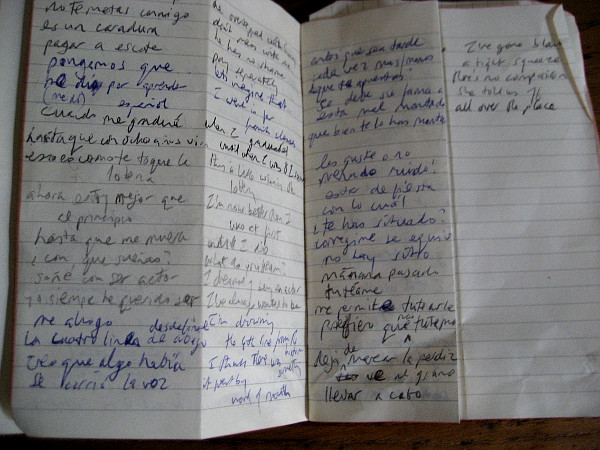
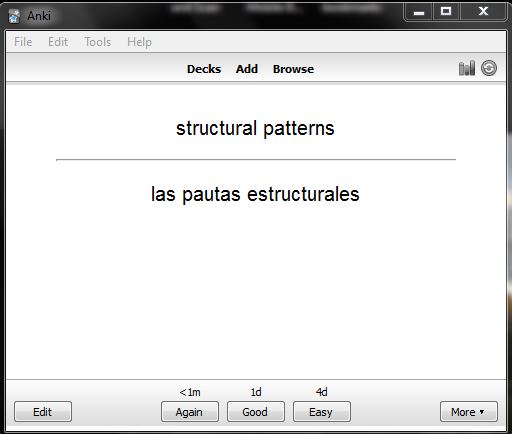
phrase notebookAccordingly, I decided from the outset to keep a notebook of phrases: ones that came up in class, or ones that I noticed in my out-of-class reading. I reinforced my stock of phrases by reference to two fat Spanish phraseological dictionaries. I keyed these all in to Anki, an excellent tool to aid memorization, which digitally replicates Paul Nation’s ‘word cards’ technique, randomizing the sequence, and calibrating the time lapse between items, on the principle of ‘spaced repetition’, according to your own assessment of the accuracy of your recall. (For more on Anki, see this link).

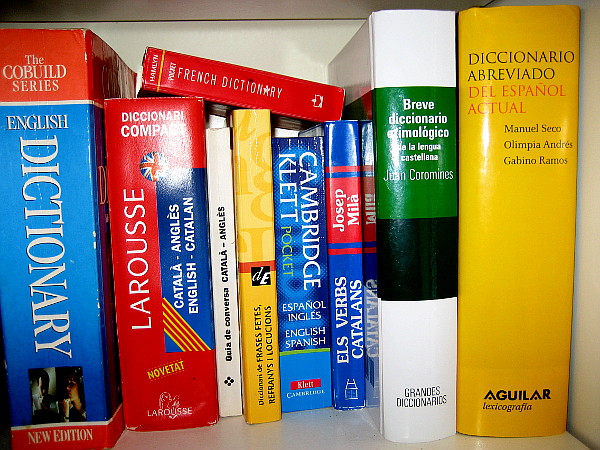
The problem is that there didn’t seem to be any real selection criteria, and hence no organizing principle, for the phrases that I was collecting and attempting to memorize. The dictionaries I consulted gave no indication as to the relative frequency of the phrases nor their register, although one of them at least had examples taken from authentic sources. But, basically I was choosing anything that sounded like it might be useful, especially those phrases – like no le caigo bien (He doesn’t like me) or yo tengo claro que… (I’m sure that…) – that would confer a degree of idiomaticity, without being too colloquial.

In light of the reconfigured objectives mentioned in the last post, i.e. the focus on presentation skills in Spanish, I decided to limit my ‘phrasicon’ to chunks that might be useful in terms of their relevance to the twin fields of language and learning, as well as chunks with high discourse functionality. That is to say, I wanted words and phrases that would help me talk about language teaching and that would also help organize and signpost this talk.

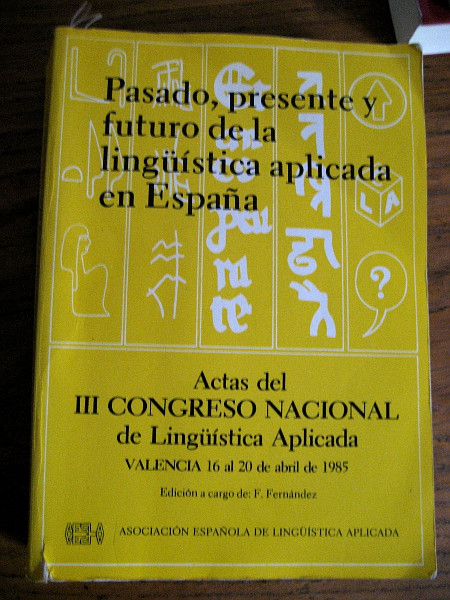
Spanish applied ling bookBut where to find them? By chance, rootling around in a second-hand bookshop in Barcelona, I came across a copy of the proceedings – in Spanish – of a conference on applied linguistics, convened in Valencia in 1985. A quick glance confirmed that what applied linguists were talking about in 1985, such as puntos gramaticales (grammar points) and un enfoque comunicativo (a communicative approach), is still very much what they are talking about now. Moreover, although the papers are (obviously) in the written mode, there seemed to be a good number of discourse markers, such as en primer lugar (in the first place) and veamos un ejemplo (let’s look at an example), that might be equally useful for giving semi-formal spoken presentations.

So, using this book as my ‘corpus’, I created two decks of word cards in Anki: academic collocations, and academic discourse markers, to which I added a third called academic sentence frames, which aims to capture constructions with variable slots that might offer templates for a degree of creativity. E.g. no hay motivo para pensar que… (there’s no reason to think that…) and lo que es importante subrayar es… (what is important to underscore is…’

anki screenshot

The Anki interface

I’ve been reviewing and supplementing these three decks while on planes and in airport lounges, as I travel round Australia on a conference junket. Having the Anki app on an iPad is ideal for this. Apart from anything else, you can synchronize the app with your home computer, keeping both up-to-date with new entries.

Is it working?  Yes and no. Recall of the phrases seems good in the short-term, but if I leave them a day or two, many of them have to be re-learned from scratch.

I suspect that the only way of making them stick is to force some kind of production, preferably in context. But what?  Maybe I need to write, rehearse and even record short (e.g. two-minute) segments of talks that embed as many of the phrases as possible.  Any thoughts?

libros fraseológicosReferences:

Ellis, N. (2003) ‘Constructions, chunking and connectionism,’ in Doughty, C. and Long, M. (eds.)The Handbook of Second Language Acquisition, Oxford: Blackwell.

Lantolf, J. and Thorne, S. (2006) Sociocultural Theory and the Genesis of Second Language Development, Oxford: Oxford University Press.

Pawley, A. & Syder, F. (1983) ‘Two puzzles for linguistic theory: nativelike selection and nativelike fluency,’ in Richards, J., & Schmidt, R. (eds.) Language and Communication. Harlow: Longman.