Monthly Archives: November 2013

The deep end

animals presentationIn a previous post (‘What drives me?’), I described how I had defined my ‘ideal Spanish-speaking self’ in these terms:

Standing in front of an audience of Spanish speakers, talking (fluently and intelligibly even if heavily accented) about teaching – IN SPANISH!

To which, one commentator responded (calling my bluff, perhaps?):

Re your ideal Spanish presenter self, how about setting yourself an achievable short-term goal? For example, the AESLA (Asociación Española de Linguística Aplicada) conference in Seville next year.

My first reaction was that this would be setting the bar too high – I’d be loathe to talk to such an august body in English let alone Spanish. Nevertheless, the challenge was intriguing.

Then I got this email from my friend Duncan Foord, at the Oxford House School of English here in Barcelona:

Re: presenting in English, as Jessica commented on the blog it can be really motivating to have something to aim for, an appointment with fate,  she suggested a talk in April. If that seems a bit far from your ZPD you could do a workshop in Spanish at Oxford House if you want. You would get a very supportive audience of English teachers, and some Spanish ones too and we could limit the size to as few as you want. You could get some feedback from a Spanish teacher too if you wanted.

tree presentationNow my bluff was well and truly called! But the more relaxed and familiar ambiance of Oxford House (I’ve spoken there before – in  English – on many occasions) offered a context a lot less threatening than an applied linguistics conference in Seville, so, not without some trepidation, I said yes. A series of emails followed, establishing the date (November 29th – just  over a week away!) and the topic:

Recargando las pilas: un estudio de casos de ‘desestabilización’

El fenómeno de fosilización es un hecho comúnmente aceptado en nuestra profesión, pero ¿de verdad el proceso de aprendizaje de otro idioma se acaba en algún momento? Como hablante, durante casi 30 años, de un castellano aparentemente estancado, este ponente ha tomado medidas para ‘desestabilizar’ su conocimiento del idioma y mejorar su fluidez. Esas medidas incluyen: tomar clases intensivas, leer, memorizar frases hechas, conversar con un profesor particular, etcétera, con la meta de hacer una presentación en castellano sobre el experimento. Esta es la presentación.

Recharging the batteries: a case study in ‘destabilization’

In our field, the phenomenon of fossilization is a commonly accepted fact. But is it true that the process of learning another language just stops? As a ‘stalled’ speaker of Spanish for nearly 30 years, the speaker has taken steps to ‘destabilize’ his linguistic competence and improve his fluency. These steps include: taking classes, reading, memorizing ‘chunks’, taking a private conversation class, and so on, with the goal of being able to do a presentation, in Spanish, about the experience. This is that presentation!

The imminence of the occasion has really concentrated my mind! So, what have I been doing as preparation?

debate1. Watching presentations

By doing a search on YouTube for Spanish-language videos that deal with the teaching of Spanish or of languages generally,  I’ve found a number of presentations that I’ve used as sources of useful ‘presentation language’  e.g. aquí tenéis…, en primer lugar…, como he dicho antes… (here you have… first of all…, as I said before…). I was also lucky enough to be able to attend a colloquium on teaching Spanish (in Spanish) at the JALT Conference in Kobe, Japan, last month.

2. Reading methodology texts

I bought a pile of books on SLA and language teaching methodology and am combing these for relevant lexis and phraseology (interlengua, zona de desarollo próximo, trabajo en parejas… etc).

3. Vocabulary study

Using the Anki software, I’ve been keying in and reviewing the vocabulary, lexical phrases and discourse markers that I’ve gathered from the above two activities.

4. Translation

Using Google Translate, I’ve been rendering my blog posts into an approximation of Spanish, and then going through them word by word, using online dictionaries and Google searches, to fine-tune them, correcting the grammar and vocabulary (where I recognize an error) and attempting – through the use of collocations, for example – to make the text more idiomatic. I then re-read these whenever I have an opportunity, and, from time to time, read them aloud.

5. Chatting

The forthcoming presentation has become a key theme in the weekly conversations I have with ‘Andrés’ (see the last post), and I use these to revisit the main themes that will form the structure of the presentation, such as identity, anxiety, willingness to communicate etc.

flower presentation6. Rehearsing

Silently and continuously, in my head, on long walks, at the gym, at three in the morning, on planes. And aloud: with another friend, herself a teacher of Spanish and experienced conference presenter, I’ve already had one ‘live’ rehearsal and have scheduled another. While useful, I’m conscious that these are not taking place in ‘real operating conditions’, and therefore lack the psychological pressure that may in fact reduce me to a yammering wreck on the day. Nevertheless, more than this I cannot do!

So, do I feel ready? Not entirely: I could do with another month at least, I feel. But, as a kind of capstone to this whole enterprise, the challenge is invigorating.

I’ll let you know how it goes!

(Illustrations from Growth in Good English, by Shane, Ferris & Keener: Laidlaw Brothers, Illinois, 1958)
The talking cure

dinner-with-andreIf, in last week’s post, I came across as a bit downhearted, this week I offer a pick-me-up.

A couple of months into this project, a Spanish-speaking friend (let’s call him Andrés) generously offered to be my regular conversation partner, not as one half of an intercambio, but simply to give me the opportunity – which I only sporadically have – to experience sustained conversation in Spanish on a regular basis. Accordingly we have been meeting once a week in a local bar for upwards of 90 minutes, with no fixed agenda, and we just talk.

The experience is liberating. For some reason, the unwillingness to communicate that I wrote about last week simply evaporates and I achieve a degree of fluidity (I’m loathe to call it fluency just yet) that I’ve only ever experienced in dreams. The talk is wide-ranging and capricious, jumping from politics to psychology, by way of travel, literature, cinema, language, language learning and relationships. The 90 minutes flash by.

When I say we just talk, it’s not quite as unstructured as that. I talk; when I’m lost for words, Andrés intervenes. He takes notes and, at the end of the day, we review some of the problems I’ve had. The experience is not unlike the one that Edmund White recounts, in his autobiographical novel The Farewell Symphony, describing Lucrezia, his private teacher of Italian:

Her teaching method was clever. She invited me to gossip away in Italian as best I could, discussing what I would ordinarily discuss in English; when stumped for the next expression, I’d pause. She’d then provide the missing word. I’d write it down in a notebook I kept week after week. … Day after day I trekked to Lucrezia’s and she tore out the seams of my shoddy, ill-fitting Italian and found ways to tailor it to my needs and interests.

mydinnerwithandre-madmanOccasionally, I’ll ask Andrés if we can do the ‘Earl Stevick’ activity. That is the one that Stevick describes in Success with Foreign Languages (1989: 148):

Another of my favourite techniques is to tell something to a speaker of the language and have that person tell the same thing back to me in correct, natural form. I then tell the same thing again, bearing in mind the way in which I have just heard it. This cycle can repeat itself two or three times… An essential feature of this technique is that the text we are swapping back and forth originates with me, so that I control the content and do not have to worry about generating nonverbal images to match what is in someone else’s mind.

This technique is particularly effective when telling stories. For example, I told Andrés about a long exchange I’d had with the elderly woman who does my dry-cleaning, in which she passionately defended socialism. Having listened, Andrés told it back, in the first person, while I tried to catch the changes and improvements. Then I had another shot at it.

And all the time I keep asking myself: If I just did nothing else, could I learn any language this way? Is this all it takes: a table, two chairs, a ‘better other’, talk, reformulation, a note book, a  glass of wine? Does it matter if the ‘better other’ is not trained, knows nothing much about pedagogical grammar, is simply a native-speaker who is good enough a listener to be able to work out what it is you’re trying to say, and can reformulate it for you?

mydinnerwithandre-almostovernowWell, when I compare these conversations with the intensive classes I took earlier this year, I have to admit that the undivided attention you get in the one-to-one situation, along with the exponential increase in talking time and the chance to choose the topics and control the direction of the talk, is a huge plus.  On the other hand, I do remember valuing enormously the capacity of those (very experienced) classroom teachers to provide on the spot explanations of elusive grammar issues in response to learners’ errors, and this is perhaps the one ingredient that I would want to add to my conversations with Andrés. The one ingredient.

This is not to suggest for a moment that I am less than completely satisfied with my conversations. I know that I can go and look up the grammar stuff in my own time: I have my notes which act as a record of the difficulties I had. More important than the grammar stuff is the fact that the conversations with Andrés have endowed me with a capacity that I’ve rarely experienced in all my years speaking Spanish: the willingness to communicate (WTC).

Until recently, WTC has been construed primarily as an internal attribute of learners: something they have. However, as MacIntyre et al (2011: 93) argue, ‘perhaps it is time to widen the scope of the WTC concept to more explicitly take into account moment-to-moment dynamics within the social situation and the key role played by the communicative partner(s).’  Or, as Yashima (2012: 132) puts it: ‘WTC can only be enhanced and developed through the social processes and communicating with others. It takes two to tango.’  my-dinner-with-andre1

My experience with Andrés confirms that the willingness to communicate is much less an individual trait than a social one: not something you have but something you make. Something you make together. In fact, Andrés himself summed it up perfectly, quoting the Spanish writer Carmen Martín Gaite:  La elocuencia no está en el que habla, sino en el que oye. (Eloquence is not in the one who speaks, but in the one who listens).

Andrés has given me my voice back.

References:

MacIntyre, P.D.,Burns, C., & Jessome, A. (2011) ‘Ambivalence about communicating in a second language: A qualitative study of French immersion students’ willingness to communicate,’ Modern Language Journal, 95, 81-96.

Stevick, E. (1989) Success with Foreign Languages, Hemel Hempstead: Prentice Hall.

White, E. (1997) The Farewell Symphony, London: Chatto & Windus.

Yashima, T. (2012) ‘Willingness to communicate: Momentary volition that results in L2 behaviour’, in Mercer, S., Ryan, S., & Williams, M. (eds) Psychology for Language Learning: Insights from Research, Theory and Practice, Houndmills: Palgrave Macmillan.

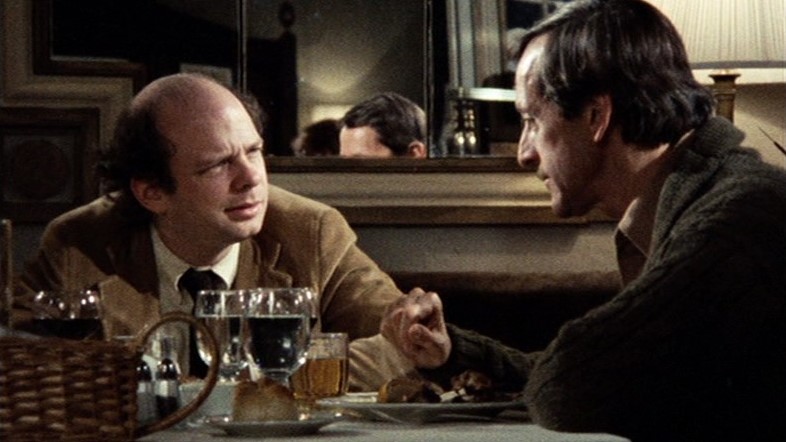
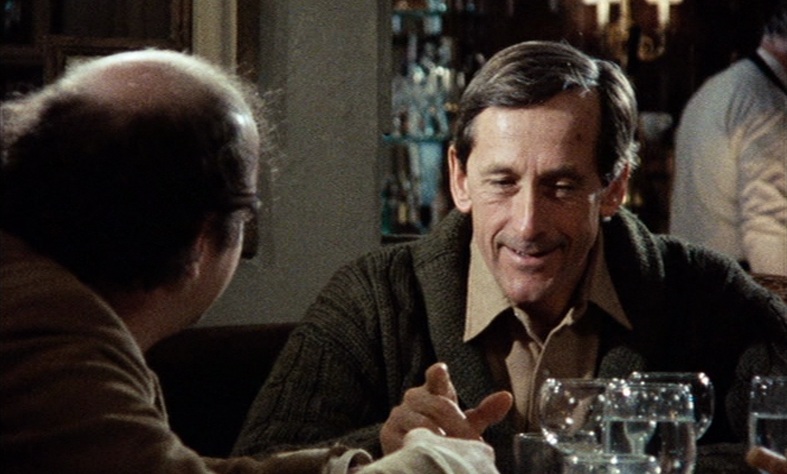
Stills from Louis Malle’s 1981 film, My Dinner with André, New Yorker Films (permission sought and pending).


Confidence tricks

GoffmanLanguage learning is often a case of taking two steps forward, then one step back.

In fact, lately it feels more like one step forward and two steps back.  It’s as if I were right back where I started. Being out of direct contact with Spanish speakers for a total of four weeks in the last two months has not helped. And a couple of negative experiences have had the effect of all but erasing my new-found confidence. Or, at least, they have exposed just how fragile that confidence is.

For instance: we are invited to a friend’s birthday party. There are lots of people we don’t know, and we are the only non-native speakers, a situation that I would normally have avoided at all costs, but which I am feeling less apprehensive about than usual, thanks to my recent Spanish ‘growth spurt’.

The initial chit-chat goes OK, but the preponderance of Catalan is daunting, and I start to worry that I won’t get much conversational mileage out of my refurbished castellano.

I am seated next to someone I don’t know, and I fluff the introductions so I don’t even catch his name. I know I should initiate some small talk but I am pole-axed with anxiety. How to begin? How to continue? Will we understand one another? And, more importantly, will he want to talk to me, once he realizes the risks that conversation with me involves?  And so on. So I orient myself away from him and towards the conversation that is going on further up the table. Nobody else is talking to him either, but by now too much time has elapsed to make starting a conversation seem natural and unforced. I pray to God the meal will be over quickly.

Later, a number of us have gathered outside in small groups, where the greater mobility afforded by standing takes some of the tension out of doing small talk. The topic, unsurprisingly, is smoking.  I start to describe the draconian anti-smoking measures I’ve just witnessed in Australia. A friend who happens to be passing raises a laugh by teasing me about my pronunciation of a particular word. Once again, I am reduced to silence. I feel I’ve been transported back 25 years.

Two failures;  two steps backward.

How to characterize these two incidents in terms of the research into SLA?

The incapacity to initiate conversation (and this happens a lot) directs me to the literature on what is called ‘willingness to communicate’ (WTC). Researchers, such as MacIntyre et al (1998 and 2011), argue that the willingness to communicate to a specific person at a specific time and place is the result of a whole constellation of social and psychological factors, some of which are inherent traits (e.g. shyness) and therefore resistant to manipulation, and others, such as one’s current state of self-confidence, which are situation-specific: ‘The state of self-confidence blends the influences of prior language learning and perceived communicative skills with the motives and anxieties experienced at a particular moment in time into a state of mind broadly characterised by a tendency to approach or avoid the L2 “right now”‘ (MacIntyre et al, 20111: 83-84).  Given that, in my Spanish classes, WTC was never a problem (in fact, I rapidly assumed the role of class clown), why am I afflicted by the lack of it in social situations such as the one I have described?

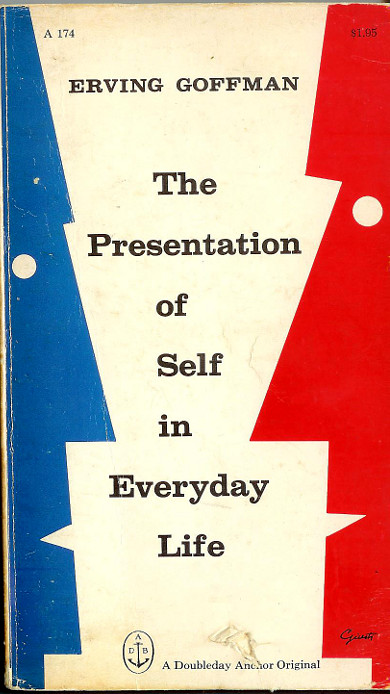
The question led me to look beyond psycholinguistics and explore sociology, specifically Erving Goffman’s performative theory of social interaction, as articulated in The Presentation of Self in Everyday Life (1959).

Goffman tellingly makes the point that ‘life may not be much of a gamble, but interaction is’ (p. 243).  Why? Because it is through social interaction that one performs oneself. But not in the sense that the self is the cause of the performance; rather, it is its product. ‘The self, … as a performed character, is not an organic thing that has a specific location, whose fundamental fate is to be born, to mature, and to die; it is a dramatic effect arising diffusely from a scene that is presented, and the characteristic issue, the crucial concern, is whether it will be credited or discredited’ (p. 253).  Pennycook (2007: 157) makes a similar point: ‘A performative understanding of language suggests that identities are formed in the linguistic performance rather than pregiven’. The problem is, then, that the self that I think I present in Spanish is a necessarily diminished one, and one that not only embarrasses me but (possibly worse) will embarrass my interlocutor.

‘The crucial concern is whether it [the self] will be credited or discredited’. My unwillingness to communicate stems from a fear of being discredited; my friend’s mockery of my accent seemed to vindicate the fact that this fear is well-founded.

Lady and the MonkAnd yet, there are second language learners who seem to be immune to such threats to self. Pico Iyer (1992: 101) describes just such a one:

Sachiko-san was as unabashed and unruly in her embrace of English as most of her compatriots were reticent and shy. … She was happy to plunge ahead without a second thought for grammar, scattering meanings and ambiguities as she went. Plurals were made singular, articles were dropped, verbs were rarely inflected, and word order was exploded – often, in fact, she seemed to be making Japanese sentences with a few English words thrown in. Often, moreover, to vex the misunderstandings further, she spoke both languages at once…

And, in a new book that celebrates the work of Richard Schmidt (Bergsleithner et al, 2013: 5), Schmidt recalls another fluent Japanese user of English, the famous Wes:

Why do people think his English is so good when he doesn’t use prepositions, articles, plurals, and tense? I think it’s because when people talk to him and listen to him, they don’t notice that he doesn’t use them.

In his 1983 study, Schmidt attributes this illusion of accuracy to Wes’s WTC: ‘It seems that his confidence, his willingness to communicate, and especially his persistence in communicating what he has in mind and understanding what his interlocutors have in their minds go a long way towards compensating for his grammatical inaccuracies’ (p. 161).

¡Ojalá que yo tuviera la misma confianza!

Dick SchmidtReferences

Bergsleithner, J.M., Frota, S.N., & Yoshioka, J.K (eds) (2013) Noticing and Second Language Acquisition: Studies, in honor of Richard Schmidt, Honolulu, HI.: NFLRC.

Goffman, E. (1959) The Presentation of Self in Everyday Life, New York, NY: Doubleday Anchor.

Iyer, P. (1992) The Lady and the Monk: Four Seasons in Kyoto, London: Black Swan.

MacIntyre, P.D., Clément, R., Dörnyei, Z., & Noels, K.A. (1998) ‘Conceptualizing willingness to communicate in a L2: A situational model of L2 confidence and affiliation,’ Modern Language Journal, 82: 545-562.

MacIntyre, P.D.,Burns, C., & Jessome, A. (2011) ‘Ambivalence about communicating in a second language: A qualitative study of French immersion students’ willingness to communicate,’ Modern Language Journal, 95, 81-96.

Pennycook, A. (2007) Global Englishes and Transcultural Flows. London: Routledge.

Schmidt, R. (1983) ‘Interaction, acculturation and the acquisition of communicative competence,’ in Wolfson, N., and Judd, E. (eds) Sociolinguistics and Second Language Acquisition, Rowley, MA.: Newbury House.


Am I past it?

cursos para seniorsI had an uncle, Uncle Reid, whose hobby was learning languages. Even into advanced old age, he was forever dipping into books like Teach Yourself Urdu or Tagalog without Tears. I have no way of knowing, now, what his level of proficiency was like in these languages. I suspect that, at best, he had a passing familiarity with the rudiments of the grammar of each one, plus a basic vocabulary. Perhaps he could read simplified texts, but I doubt he could sustain a conversation over any length of time.

Nevertheless, the fact that his age was no deterrent should serve to encourage me, and allay my doubts that I might have left this present endeavor too late.  As motivated as I am, ‘at my back I always hear/Time’s wingéd chariot hurrying near’.  Do I seriously believe I can reconfigure my Spanish, aged 63? Is there any evidence to suggest that I can?

Consult any book on SLA and you’ll find a lot of page space dedicated to the effects of age (or ‘maturational constraints’) on language acquisition. Questions discussed include: Is there an optimal age for learning a SL? What is the effect of different ‘ages of onset’? Are different learning processes implicated at different ages? Is native-like proficiency achievable after a certain age? And so on.

But look closely and you’ll find that all the research cited compares children with adolescents, or adolescents with young adults.  None of the research looks at mature learners, or attempts to address the question: Do maturational constraints increase with age? Or even, Is there an age of onset beyond which second language learning is not predicted?

Italian 50+On the other hand, if you google ‘am I too old to learn a language?’ you’ll find a host of happy-clappy blog posts, webzine articles etc, that – on the basis of only anecdotal evidence at best – are hugely encouraging about the ease of learning French in your retirement, or Spanish at 50. Language schools, too, offer ‘courses for mature students’, on the principle, presumably, that mature students prefer to study together, undistracted by frivolous teenagers, or – more worryingly – that mature students, due to their cognitive impairments, need special attention.

On the subject of older learners and second language acquisition, I managed to turn up only one serious study (Schulz and Elliot 2000). As the researchers point out, most studies of (old) age and SLA focus on language attrition, that is, language loss in multilingual subjects, but not on the acquisition of new languages by older learners. In their study, Schulz and Elliot report on how one of the pair (Renate Schulz, a 57-year-old professor of German) learnt Spanish during a five-month academic fellowship in Colombia.

Prefacing this account with a review of the literature on ‘cognitive aging’, they note that older adults ‘may not be able to retain information in short-term memory as well as they did before, or to process information as quickly…. They may have more difficulties in retrieving language-related information’ (2000: 109). This typically manifests itself as what is called the ‘tip-of-the-tongue’ (TOT) phenomenon, whereby a word is temporarily inaccessible. ‘When older learners have a TOT experience, they tend to have fewer persistent alternates, that is, they recall fewer alternate words that resemble, in some fashion, the word they wish to retrieve’ (ibid.).  This seems to be less due to a failure of memory than to a decrease in processing speed.  ‘In summary, the research to date has shown that an older adult requires more time for many cognitive tasks and experiences more word-finding difficulties’ (ibid.)

Schulz’s own diary entries during her spell in Colombia often report some of these difficulties, such as a frustration at her inability to recall verb endings, or the problems of decoding rapid speech.  For example (p. 112):

(May 30) I get the general gist of the message, and only later (sometimes after an interaction with someone is completed and I’m doing something else) I suddenly fully understand what has been said in the previous encounter.

Sometimes I perceive myself as if I comprehend and react in slow motion!

Nevertheless, she also experienced some breakthrough moments:

(April 5) Yesterday I addressed the entire department in Spanish for several minutes before I suffered a “linguistic breakdown” and had to revert to English. Later I participated in the discussions in Spanish as well. Amazing what adrenalin can do!

(June 6) I went to see a play with C. J. I was very pleased how much I understood. I had no problem following the general plot, but did not always get the humour that caused audience to laugh.

In fact, on various objective measures of her vocabulary and grammar, both before and after the experience, she demonstrated significant improvement over the five months, suggesting that, if there were any cognitive disadvantages associated with a being ‘a mature learner’, she was able to overcome them. This is good news for me!cursos senior

Finally, and with regard to the pedagogical implications of their study, the researchers suggest that older learners may be less tolerant of classroom activities that are perceived as frivolous or time-wasting. The following comment (p. 117) chimes precisely with my own classroom experience although I’m not sure that this is necessarily an age-related issue:

Interestingly, Schulz, who in her own teaching and teacher development efforts emphasises the tenets of communicative approaches to foreign language teaching, reacted in her diary occasionally with frustration to role-play and other simulation activities. Group activities which consist of “working on inconsequential, semi-defined tasks with people who are less competent than I am” (diary entry from mid-February) also raised her ire, and in several diary entries she expressed a desire for more challenging and engaging contents.

Perhaps this proves merely that teachers make demanding learners!

Reference:

Schulz, R.A., & Elliot, P. (2000) ‘Learning Spanish as an older adult,’ Hispania, 83/1, 107-119.